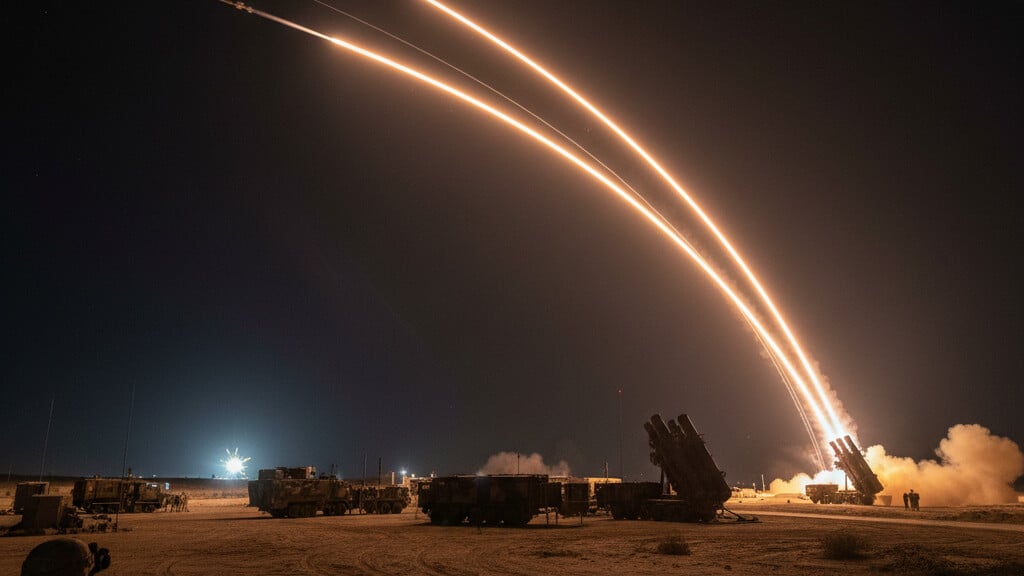
America’s missile defense systems are performing brilliantly against Iran’s salvos. There’s just one problem: we’re running out of interceptors to fire.
Defense technology analyst Reuben F. Johnson is calling it a “full-blown crisis.” The Patriot PAC-3 MSE, THAAD, and SM-3 systems deployed across the Middle East have achieved near-perfect intercept rates against Iranian ballistic missiles, cruise missiles, and drones. The technology works. But the “just-in-time” production model that the defense industry adopted decades ago — the same lean manufacturing philosophy that works great for car parts — has left the U.S. military with dangerously low inventories of the very weapons proving most critical in this conflict.
The Production Problem
Each Patriot PAC-3 MSE interceptor costs approximately $4 million. THAAD interceptors run about $12 million apiece. SM-3 Block IIA missiles — the ones the Navy uses to shoot down ballistic missiles from Aegis destroyers — cost roughly $36 million each. These aren’t items you can reorder from Amazon Prime. Production timelines for advanced interceptors are measured in years, not weeks.
LIVE: @SecWar and @CENTCOM commander, Adm. Brad Cooper, conduct a press conference at U.S. Central Command in Tampa, Fla. https://t.co/f0KGGCvMQY
— Department of War 🇺🇸 (@DeptofWar) March 5, 2026
The U.S. entered this conflict with stockpiles designed for short, intense engagements — not a sustained campaign against a nation-state capable of launching hundreds of missiles across multiple theaters. Six days into Operation Epic Fury, the math is becoming uncomfortable. Every Iranian salvo that gets intercepted is a victory for American technology and a defeat for American logistics.
Strategic Overstretch
The crisis extends far beyond the Middle East. The United States maintains missile defense commitments across three major theaters: the Middle East, the Indo-Pacific (where China and North Korea represent growing threats), and NATO’s eastern flank (where Russia’s missile capabilities remain a constant concern). Every interceptor fired at an Iranian missile in the Persian Gulf is one that isn’t available to defend Taiwan, Japan, South Korea, or Poland.
This isn’t a theoretical concern. Military planners have known for years that interceptor stockpiles were insufficient for a multi-theater conflict. The Government Accountability Office testified before Congress this week on military readiness, noting that the Department of Defense “should take further actions to address challenges across the air, sea, ground and space domains.” The diplomatic language masks an urgent reality: the cupboard is getting bare.
The Path Forward
The solutions are known but not fast. In the near term, the defense industry needs emergency production authorizations and funding to ramp up interceptor manufacturing. Lockheed Martin, Raytheon, and the other prime contractors have the capacity to accelerate production, but only if the money and political will are there.
In the longer term, the U.S. must pivot toward lower-cost missile defense solutions. Directed energy weapons — high-powered lasers and microwave systems — offer the promise of nearly unlimited “ammunition” at a fraction of the cost per engagement. The technology exists in prototype form. What’s been missing is the urgency to deploy it. Iran’s missile barrages may have just provided that urgency.
Defense Secretary Hegseth’s assurance that “our munitions are full up” is technically accurate in terms of offensive capability. But the defensive side of the equation — the interceptors that keep American servicemembers and allied populations alive — tells a different story. One that the Pentagon would prefer you not hear just yet.
Providence watches over the bold.
About The Author
