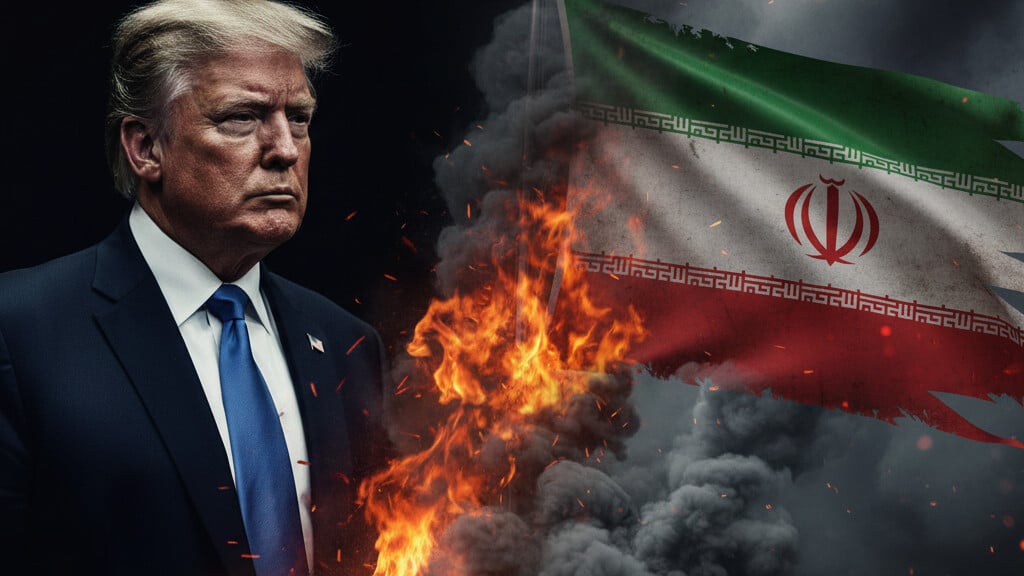
Editorial illustration
The regime is crumbling, and Donald Trump isn’t waiting for the dust to settle before staking his claim on what comes next.
In a phone interview with Reuters on Thursday — day six of a joint U.S.-Israeli campaign that has systematically dismantled Iran’s military infrastructure — the President said what no American leader has dared to say out loud in four decades. “We want to be involved in the process of choosing the person who is going to lead Iran into the future.”
He’s not just prosecuting a war. He’s already shaping the aftermath.
“A Lightweight”
Ayatollah Ali Khamenei was killed in the opening salvos of the conflict, and the question of who replaces him has become the central geopolitical puzzle of the moment. Mojtaba Khamenei — the Ayatollah’s 56-year-old son and rumored front-runner — has never been elected or appointed to a government position. He’s a backroom operator, the kind of figure who thrives in shadows and owes his relevance entirely to bloodline. Trump’s assessment in an Axios interview was characteristically blunt: “A lightweight.”
Then came the pitch — not to diplomats or the U.N., but directly to the Iranian people. “Help take back your country,” Trump urged, promising “total immunity” for those who rise up against the regime. And because this is Trump, the alternative came with no sugar coating: “Or you’ll face absolutely guaranteed death.”
Whether that kind of rhetoric proves effective remains to be seen. But nobody can accuse the man of ambiguity.
Fourteen Countries in Six Days
What began as precision strikes on Iranian nuclear and military targets has metastasized into something far larger. The conflict has now drawn in 14 countries across the Middle East and beyond, expanding in ways that would have seemed unthinkable a week ago.
Azerbaijan is accusing Tehran of drone attacks. An Iranian warship now sits at the bottom of the Indian Ocean near Sri Lanka, courtesy of the U.S. Navy. Israel has issued mass evacuation warnings for Beirut’s southern suburbs — Hezbollah’s backyard — and U.N. peacekeepers in southern Lebanon are reporting ground combat as Israeli troops push across the border for the first time in years.
Iran continues to swing back with retaliatory strikes on Israel, the UAE, and Qatar. A missile hit a refinery in Bahrain. The U.S. has now struck or sunk over 30 Iranian ships, including a drone carrier that CENTCOM described as the size of a World War II aircraft carrier.
Defense Secretary Pete Hegseth, speaking from Central Command headquarters in Florida, delivered perhaps the most consequential line of the week: “Iran is hoping that we cannot sustain this, which is a really bad miscalculation. Our munitions are full up and our will is ironclad.”
Operation Epic Fury: The first 48 hours pic.twitter.com/uCQqHq5Ajx
— U.S. Central Command (@CENTCOM) March 2, 2026
The human cost continues to climb. At least 1,230 dead in Iran, over 120 in Lebanon, around a dozen in Israel, and six American servicemembers who won’t be coming home.
Washington Falls in Line
The political winds in Washington tell their own story. House Republicans killed a resolution Thursday that would have forced a halt to the bombardment, and the Senate voted down a similar measure the day before. The antiwar vote didn’t just fail — it wasn’t close. The establishment GOP, the same crowd that spent four years wringing its hands over every Trump tweet, lined up behind their commander-in-chief when it actually mattered.
Trump also signaled support for an Iranian Kurdish offensive, telling Reuters he’d be “all for it.” He wouldn’t say whether the U.S. would provide air cover, but the fact that his administration has maintained contact with Kurdish groups since the first day of strikes tells you where this is heading.
What This Is Really About
Strip away the cable news hand-wringing and the reality is straightforward. For 45 years, the Islamic Republic of Iran has served as the central node of terror in the Middle East — funding Hezbollah, arming Hamas, backing the Houthis, and propping up every proxy militia that has destabilized the region since 1979. Every rocket, every kidnapped sailor, every murdered American soldier — the thread runs back to Tehran.
The establishment’s answer was the JCPOA — a deal that was supposed to welcome Iran into the community of nations. What it actually accomplished was flooding the regime with billions in sanctions relief while greenlighting a delayed nuclear weapons program and buying a few years of comfortable fiction for diplomats who preferred cocktail parties to confrontation.
Trump is offering something fundamentally different. Not management of the problem, but resolution. You can debate the wisdom of it, question the endgame, and worry about the consequences. But you cannot accuse this administration of being unclear about what it’s doing or why.
A Prayer for What Comes Next
Pray for our troops — the ones flying those sorties over Tehran, manning the ships in the Persian Gulf, and standing watch in places most Americans couldn’t find on a map. Six of them have already given everything they had to give.
Pray for the Iranian people — not the regime, but the people who took to the streets in 2009, in 2019, and again in 2022, only to be beaten, shot, and hanged for daring to demand something better. They have always deserved better than theocratic tyranny.
And pray that whatever rises from these ashes proves worthy of one of the oldest and proudest civilizations on earth.
Providence watches over the bold.
About The Author
